
Introduction
Copper is one of the most useful metals in modern industries. It’s used in nearly every installation as this material has a long service life, is extremely strong, and has excellent conducting properties, such as electrical wiring and electrical power systems, plumbing lines, and machine components from the factory to the home.
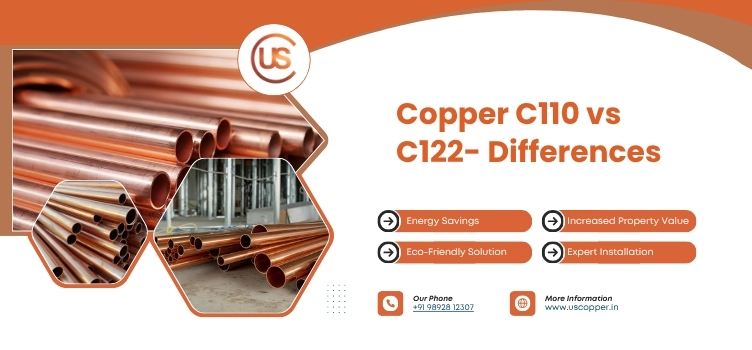
Copper is treated to form different grades for various applications. Copper C 110 and Copper C 122 are two popular copper grades that are used across various industries. Firstly, C110 is preferred for certain high electrical conductivity applications; secondly, C122 is preferred for applications that demand easier welding, corrosion resistance, and reliability.
But by selecting the appropriate copper grade, performance, reliability, and overall efficiency are enhanced in any application.
What is C110 Copper?
C110 Copper is a widely used, high-purity grade of copper, most commonly used for electrical wiring. It is found in applications where smooth and efficient needed and can handle electrical currents and prevent heat buildup.
Key Points:
- Very high purity (around 99.9%)
- Very good electrical conductivity
- Heat transfer plates with good abilities
- Easy to work with, shape, or form for making products
- Reliability in electric function is known as
Common Uses:
- Electrical wiring and cables
- Transformers and motors
- Transformation stations, switchgear, and electrical panels
- Industrial electrical equipment
What is C122 Copper?
C122 Copper or Deoxidized High Phosphorus (DHP) Copper is a grade of copper, better known for its ease of fabrication and durability. Adding a little bit of P will make it easier to weld and to resist oxidation.
Common applications are those in which mechanical strength and ease of joining are more important than very high electrical conductivity
Key Points:
- Phosphorus is present in traces
- Good corrosion resistance and oxidation resistance
- Very good weldability and brazing quality
- Excellent hot/cold tolerance
- Advantageously lower conductivity than C110
Common Uses:
- Plumbing fittings and pipes
- HVAC systems
- Heat exchangers
- Water supply systems
- Industrial tubing and fabrication process
C110 vs C122 – Key Differences
| Feature | Copper C110 | Copper C122 |
| Nomenclator Tdnz Brass | ~99.9% pure copper with very little phosphorus | Brass with a low percentage of phosphorus |
| Electrical Conductivity | Very high | Moderate (Not so high as C110) |
| Weldability | Good, but limited for heavy welding | Excellent weldability and brazing |
| Environmental Durability | Good | Better ability to resist oxidation and other environmental influences |
| Strength | Standard copper strength | Improved Strength in Heat Conditions |
C110 is best for Electrical performance, and C122 is good for Plumbing, Welding, and Durability Applications.
Properties of C110 and C122 Copper
Copper C110 – Properties:
- Super high purity (>99.9% copper)
- Excellent electrical conductivity
- High thermal conductivity
- Can be shaped and produced easily
- Excellent corrosion resistance in normal environments
Copper C122 – Properties:
- Copper alloy is an alloy combining copper as the primary chemical composition, so the content of phosphorus is very small
- Copper C122 – Properties
- Good electrical conductivity
- Excellent weldability and formability for fabricating
- Excellent rust and corrosion resistance
- Realizes good performance under heat and pressure
C110 offers conductivity and performance, while C122 is prized for its durability and fabrication.
What to choose?
If your results meet the following criteria, select Copper C110:
- High electrical conductivity is required
- You’re wiring, servicing motors, or electrical systems
- This isn’t a major requirement for welding
- Performance in electricity flow is the priority
If: use Copper C122:
- Excellent weldability and brazing ability required
- You are busy with plumbing, piping, or HVAC jobs
- Resistance to corrosion and oxidation is considered to be important
Applications of C110 and C122 Copper
- Electrical wiring and power cables – MWD 2010
- Busbars in Electrical Panels
- Transformer and electric motors
- Switchboard and control devices
- Power distribution networks
- Electronic and industrial electric parts
- Heavy-duty electrical equipment
Conclusion
Copper C110 and copper C122 are both high-quality materials, but are utilized for different industrial applications. No other metal is as conductive as C110, an alloy that is used for wiring, motors, and power systems. Conversely, C122 has enhanced weldability, corrosion resistance, and endurance characteristics, which are ideal for plumbing, HVAC, and piping industry uses.
FAQs
Q1. Cu1 or Cu2 conducts more heat?
The C122 works well in moist and high-heat/manufactured environments.
Q2. Is C110 good in corrosion?
By itself, it is fair to say that it is not that resistant, though that doesn’t mean C122 doesn’t work in such an environment.
Need help choosing between C110 and C122 copper? Whatever you need in terms of high conductivity (C110) or better weldability and corrosion resistance (C122), call us or email us at sales.uscopper@gmail.com for expert advice.